• Living & Home

Not Just Salt – A Rich Source of Minerals

Nine-Times-Baked Bamboo Salt: A Mineral Treasure
image

You may have heard that “nine-times-baked bamboo salt” is beneficial for the body, but it can be hard to imagine what “baked nine times” actually means. That’s because most people never get to see the process firsthand. When you watch the baking process through video or other media, it becomes easier to understand why this unique salt is so highly valued—and why it comes at a higher price.

Each round of high-temperature baking creates a powerful synergy between the bamboo, yellow clay, and pine wood fuel. Through this repeated process, the salt becomes enriched with a wider variety of minerals. More than just a product, nine-times-baked bamboo salt is the result of time, patience, and careful craftsmanship built up over many firings.


The Number 9: A Symbol of Completeness and Top Quality

You might wonder, "Why nine times?" There’s no strict rule that it must be baked exactly nine times. In both Eastern and Western cultures, the number 9 represents completeness, fullness, and the highest level. Similarly, the nine-time baking process is believed to maximize the salt’s effectiveness, reflecting this idea of completeness. In practice, the more the salt is baked, the more impurities, toxins, and excess saltiness are removed. At the same time, beneficial compounds from the bamboo and red clay gradually infuse into the salt, increasing its mineral content.

Sun-Dried Salt Aged Over Three Years Until Completely Moisture-Free

Now, let's take a closer look at the meticulous process behind creating bamboo salt through nine firings.
First, clean, high-quality sun-dried salt is prepared. For reference, Atomy uses only sun-dried salt from the West Sea coast, which has been stored for over three years until all moisture is completely removed. This salt is then packed into giant bamboo barrels rich in natural sulfur—specifically, barrels made from bamboo that has grown for more than three years.

Filling the bamboo barrels is a critical step. The salt must be packed tightly with no empty spaces, which prevents air from getting between the grains, avoiding oxidation and contamination, and also reduces the risk of the bamboo splitting. Proper packing ensures heat spreads evenly during baking, resulting in consistently high-quality bamboo salt. Finally, the opening of the bamboo barrel is sealed with red clay to keep out any foreign substances.

The Manufacturing Process of Nine-Times-Baked Bamboo Salt
image image
Packing Sun-Dried Salt Tightly into Giant Bamboo Barrels
Eight Cycles of Firing at Over 800°C for 48 Hours

The bamboo tubes are first filled tightly with sun-dried salt. They are then placed in an clay cave and fired using only natural pine wood, following the traditional method at temperatures exceeding 800°C for 48 hours. After firing, the salt is carefully removed from the bamboo tubes. Once cooled, the bamboo salt is packed into new giant bamboo tubes and undergoes another 48-hour firing in the clay cave. This process is repeated eight times to ensure maximum purity and quality.

The Ninth Firing at Over 1300°C: Creating Bamboo Salt Stone

The final step! The salt—already baked eight times and packed into giant bamboo barrels—is fired one last time at temperatures exceeding 1300°C. At this extreme heat, the salt completely melts, turning into a red or purple molten liquid that looks like lava. Once it cools, it solidifies into jukyeomseok (Bamboo Salt Stone). Depending on how finely this stone is crushed, it becomes either the powdered or crystalline bamboo salt that we use at home.

image image
Reduced Saltiness with Over 80 Rich Minerals

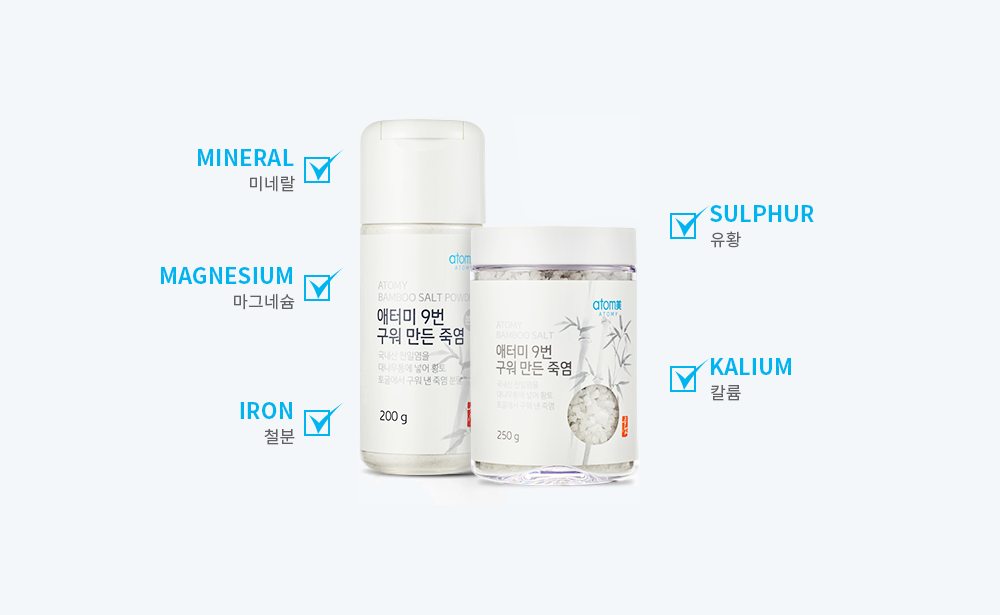
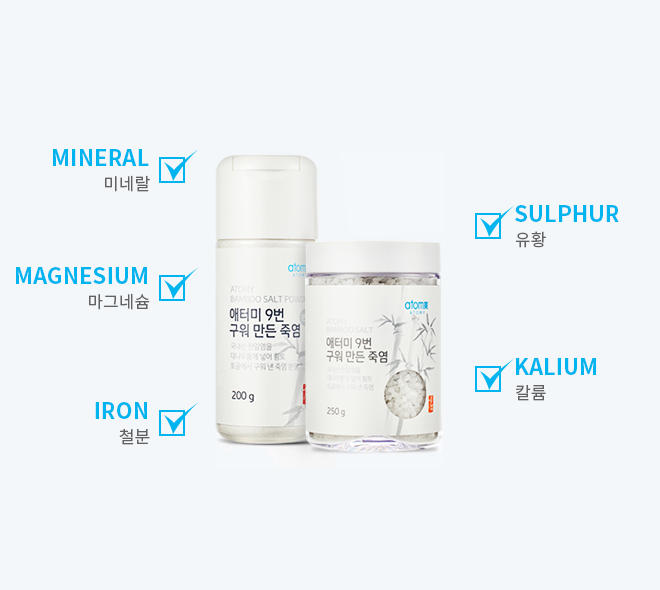
Through the nine-time baking process, the sodium chloride (NaCl) content of the salt is reduced by nearly 50%, making it less salty. At the same time, it becomes a strongly alkaline food, enriched with a wide range of minerals such as magnesium, sulfur, potassium, and iron.
In general, nine-times-baked bamboo salt is known to contain over 80 different minerals. It is believed to support detoxification and body purification, provide anti-inflammatory and antibacterial benefits, help maintain an alkaline body balance, improve digestion, and boost immunity.

image image
How to Use Bamboo Salt: Eating, Oral Care, Bathing, and More
    • image
    • Eating

      Place an appropriate amount of bamboo salt in your mouth and let it slowly dissolve, or dissolve it in water and drink.

    • image
    • Cooking

      Use bamboo salt to season dishes for healthier meals. The powdered form is especially convenient.

    • image
    • Brushing and Gargling

      Apply bamboo salt to a toothbrush or your finger, gently massage your gums, and then rinse. After brushing with toothpaste, rinsing once more with diluted bamboo salt water can further support oral health.

    • image
    • Bathing and Bathing Bomb

      For a full-body application, wet your skin, then evenly apply bamboo salt and massage it in before rinsing with lukewarm water. As a bath bomb, dissolve the appropriate amount of bamboo salt in lukewarm water and soak in it.

Bamboo salt can be used in so many ways! Its minerals help nourish your whole body and support better health.

Interview with Inventors
  • image
    Jeong Rak-hyeon CEO of Kaeam Bamboo Salt (First Certified Bamboo Salt Master)
    Dedicated to Producing “Bamboo Salt Baked Nine Times” Using Traditional Methods

    Kaeam Bamboo Salt is a specialist company with 35 years of experience, devoted entirely to making bamboo salt. We faithfully follow the traditional recipe without simplifying or shortening any part of the process. Each batch is carefully baked eight times in an clay cave, then completed on the ninth firing.
    Bamboo naturally contains sulfur, and the inner bark, called jukye, is especially valuable. We use only native bamboo rich in jukye and high-quality sun-dried salt from Gomso, Buan, Jeollabuk-do. The salt must be tightly packed at every stage of the process. The next step involves cutting fresh bamboo, crushing the salt pillars baked once, and adding them for the next round. This mixture is then baked repeatedly for 48 hours at a time, eight times in total, inside the clay cave. Compared to regular sun-dried salt, bamboo salt contains only 55% to 60% sodium chloride (NaCl), making it about half as salty.
    “Our goal is to continue perfecting bamboo salt until the day it is enjoyed on tables around the world."
  • image
    Na Imjeong Director of Health Food Research Center of Orot
    When Minerals Are Abundant, the Immune System Thrives!

    If we take the activity of ordinary proteins as a baseline of 1, minerals can act like catalysts, increasing their activity by more than 100,000 times. This means that people who get plenty of minerals tend to be much healthier with stronger immune function. Moreover, minerals like sulfur found in pine and bamboo naturally combine during the bamboo salt process, reducing sodium content while increasing mineral content. With such a wide variety of minerals, bamboo salt is truly a traditional, mineral-rich food—a genuine “treasure trove of minerals.