This Summer
Summer-Friendly Foods and Healthy Habits
Enjoy Healthy Joints With Atomy Turmacin MSM!
Healthy Joints, A More Comfortable Life Ahead
Joints can be described as a “connection system between bones” in which various tissues—such as cartilage, synovial fluid and the synovial membrane, ligaments, tendons, and muscles—work together to enable movement and support the body. They perform multiple functions simultaneously, including movement, weight-bearing, and shock absorption. Joints are considered healthy when the joint system functions properly and these roles are maintained in balance.
Cartilage, a key component of the joint system, is a soft tissue that covers the ends of bones. It acts as a cushion that prevents bones from directly contacting each other whenever we move, absorbing shock and minimizing friction. Given its essential role, cartilage has the following characteristics, which require consistent care in daily life.
First, cartilage lacks blood vessels, so it cannot receive oxygen and nutrients directly from the bloodstream; as a result, regeneration and recovery are very slow once it is damaged.
Second, cartilage lacks nerves, so it does not produce immediate pain signals even when it wears down or is damaged. By the time symptoms are noticed, the condition is often already significantly advanced.
Third, cartilage lacks lymphatic vessels, so waste products and inflammatory substances are removed only through diffusion via synovial fluid and surrounding tissues. Consequently, recovery is slow when damage occurs, and inflammation tends to persist.
As cartilage within the joint gradually wears away, and damage and inflammation affect the bones, joint capsule, and surrounding ligaments, pain can develop. Once joint pain begins, it may lead not only to reduced physical activity but also to issues such as loss of confidence and feelings of depression. Joint problems can arise from various causes, including excess weight, genetic factors, aging, joint injuries, and inflammation-induced cartilage damage.
Joint pain often develops as the various tissues that make up the joint gradually degenerate, become damaged, and weaken due to aging and other factors. This leads to a broader functional impairment of the joint, involving changes not only in the cartilage but also in the entire joint system. Most joint problems in middle age and later in life can be attributed to this process.
The key to joint health is not complete rest, but regular, gentle movement within a comfortable range to support synovial fluid circulation. Low-impact exercises such as walking, cycling, and swimming can help improve the cartilage environment.
It is also important to strengthen the muscles around the joints, as this helps reduce the load placed directly on the cartilage. Maintaining a healthy body weight and proper posture are among the most practical ways to protect cartilage. On the other hand, activities that place excessive stress on the joints—such as high-impact sports, sitting in the same position for long periods, sitting cross-legged or squatting for extended periods, lifting heavy objects, or driving for long hours—should be avoided.
As population aging accelerates, the number of people suffering from joint problems continues to rise, and this trend is expected to intensify in the future. It is essential to take preventive measures before joint problems develop, and if they do occur, to seek early treatment and manage them properly to slow disease progression. Let’s keep in mind that putting off joint care now may lead to much bigger problems later.
[Source and Citation] Hyundai Asan Medical Center (Disease Encyclopedia), Korea Disease Control and Prevention Agency (National Health Information Portal)
* The above content is general health information not directly related to the product.

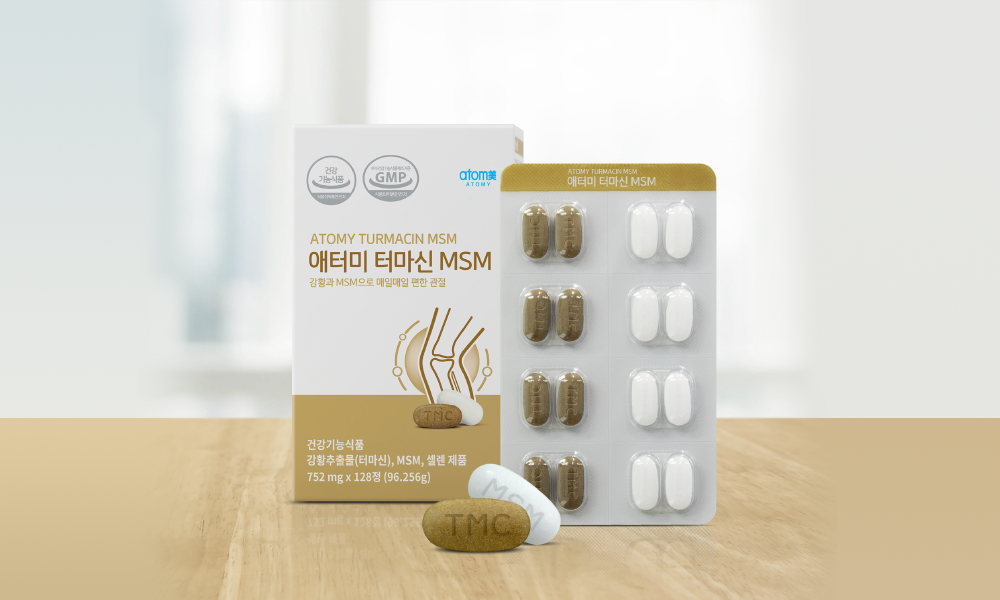
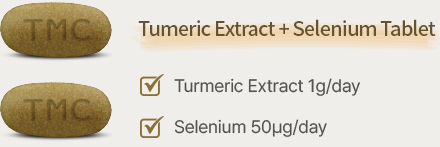
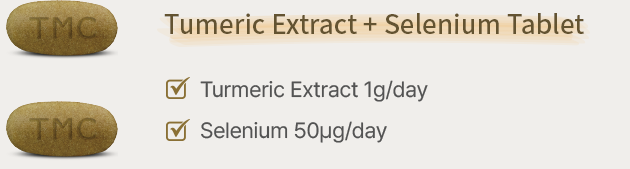
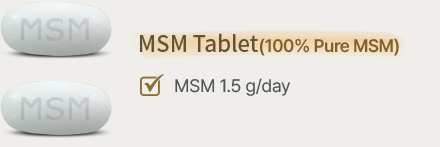
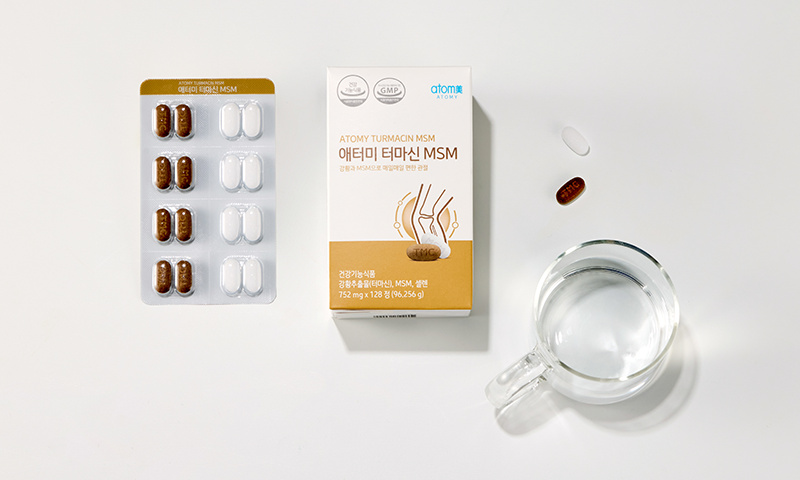
Atomy Turmacin MSM is a joint health supplement formulated with three functional ingredients: turmeric extract, MSM, and selenium. By taking two tablets of the turmeric extract and selenium in the morning, along with two MSM tablets in the afternoon, it may help support joint and cartilage health while also protecting cells from harmful oxygen radicals.


* Derived from food-based ingredients.
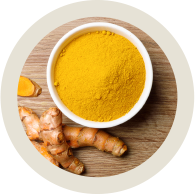
Turmacin, a turmeric extract, is a functional ingredient individually recognized by the Ministry of Food and Drug Safety for supporting joint health. It is a 100% water-soluble ingredient extracted from premium Indian turmeric through a rigorous 13-step process. It is considered a rare and valuable ingredient, with only 0.0305kg of extract obtained from 600kg of raw turmeric.
Clinical studies on Turmacin have shown significant improvements in overall quality-of-life measures, questionnaire-based scores, and Visual Analog Scale (VAS) scores.
* Yield may vary.
* Results may vary by individual
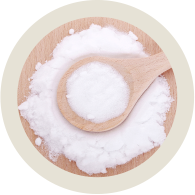
MSM (methylsulfonylmethane) is a naturally occurring organic sulfur compound found in the body, particularly in cells and proteins. Sulfur is a key component of joint cartilage and plays an important role in maintaining cartilage health. MSM serves as a source of sulfur, but since the body cannot produce it on its own, it must be obtained through the diet. While the Ministry of Food and Drug Safety recommends a daily intake of at least 1,500mg, the average daily intake among the general population is less than 50mg, making additional supplementation necessary. Clinical studies have also shown that MSM may help relieve joint-related discomfort, including pain.
* * Results may vary by individual
* WOMAC (Western Ontario and McMaster Universities Osteoarthritis Index) =
An assessment scale used to evaluate the level of pain and discomfort in individuals with joint issues
[Source] L. S. Kim, et al. Efficacy of methylsulfonylmethane (MSM) in osteoarthritis pain of the knee:
a pilot clinical trial. Osteoarthritis and Cartilage. 200;14:286-294
Selenium is an essential micro-mineral found in the body in very small amounts, yet it plays a vital role in various physiological functions. Often referred to as the “miracle mineral” or “dream mineral,” it may help protect cells from oxidative damage caused by harmful oxygen species. Joint-related tissues—including cartilage, ligaments, and muscles—are particularly vulnerable to oxidative stress, and selenium may help slow this process.